Blog Posts
Links to the most recent posts on my Math Education Blog.
Designing Great Lessons
Michael Pershan, in his Substack, discusses what he likes about my curriculum creations. Using several illustrated examples, he zeroes in on four features: using simple instructions, going from the specific to the general, focusing on a central concept, and making student-friendly worksheets. In this blog post, I quote most of his piece, and insert some links and comments.
A Teacher's Journey

This is a guest post by Marcus Elbel, a high school math teacher in Pennsylvania. He shares an overview of his evolution over 12 years in the classroom, and mentions how my materials played a key role in his growth. "It is an understatement to say that Henri Picciotto has revolutionized my classroom. Between his books, website, and blog posts, I learn something new every time I encounter his work. His website is a treasure trove of lessons, investigations, puzzles, and ideas that promote sense-making and deep mathematical thinking."
Reaching Consensus
Even in this era of standards, we may not be able to reach consensus across our whole profession. But departmental consensus in a school is attainable. In this post, I propose a path forward. Over time seeking consensus will yield a department that is more than the sum of its teachers. Students will appreciate the consistency and lose interest in comparing one teacher to another. Most importantly, their learning will be enhanced, as they will benefit from the combined contributions of the whole department.
MathEducation.page
Visit my website!
Here are links to the materials mentioned in "Designing Great Lessons" and "A Teacher's Journey".
Map Coloring
This is an "enrichment" topic. I've used this activity at all levels from 3rd grade on up, including with teachers.
Geometry Labs
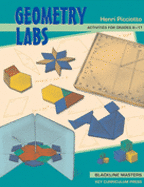
This is a free-to-download book filled with a wide range of mostly hands-on activities. Among those, Michael mentions Clock Angles (Lab 1.3), Polygon Angles (Lab 3.8, or perhaps most of Section 3, leading to it), Polyomino Perimeter and Area (Lab 8.1) and Simplifying Radicals (Lab 9.3, towards the end of a whole unit, Labs 8.4 to 9.4).
Nothing Works
This is one of several articles where I argue for teacher eclecticism. Nothing works for all students, all classes, all teachers, all schools, all districts... Therefore, we need to be flexible and open-minded. Scroll to the end of this newsletter for information on a book that incorporates and updates this article and its companion pieces.
Pyramid Puzzles
This is one of the most popular pages on my website. I use a standard format for number puzzles that involve only addition. I suggest and support students' search for a generalization, and extend the activity by encouraging them to create their own puzzles. As is de rigueur these days, I include a video for the teacher.
Algebra: Themes, Tools, Concepts
This is another free-to-download book. Using it as a textbook is probably not a good idea as it is 30 years old, and its structure is a bit opaque. But it is filled with excellent lessons ranging from pre-algebra to Algebra 2, so it can be a source of inspiration and materials at all those levels.
Lab Gear
Even in the age of AI, a grasp of the fundamental structures of algebra remains crucial. Intelligent use of manipulatives can help. The Lab Gear provides a hands-on approach where the inner logic of the model replaces the memorization of seemingly arbitrary rules. The Lab Gear is more effective, more comprehensive, and far more popular with students than algebra tiles.

Pentominoes
Pentomino puzzles were my first published materials. They have some curricular uses while at the same time being a welcome break from the classroom routine. My virtual pentominoes are among the most visited pages on my website.
Make These Designs
This is a classic activity using an electronic grapher to get across (or review) the meaning of m and b in `y=mx+b`. It is accompanied by a philosophical piece for teachers on the intelligent use of graphing technology. Dan Meyer calls it a "hall-of-famer".