Blog Posts
Links to the most recent posts on my Math Education Blog.
Makeover or Heart Transplant? ❤️
Some time ago, Michael Pershan wrote a piece about what makes the lessons I design so effective. I responded here. Dan Finkel agreed with Michael about the effectiveness, but disagreed about how to explain it. Of course, I am flattered that two expert math educators are having this conversation about my creations. While I largely agree with Dan's points, I think that the effectiveness of curriculum materials is more complicated than either his explanation or Michael's would suggest. Both of them are right, but neither of them tells the whole story. I try to in this blog post.
The Lab Gear in Algebra 1
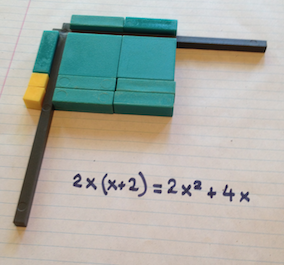
Veteran public school math teacher Carlos Cabana has mentored many student teachers over the years. During the recent summer break, he interviewed his most recent two mentees about their use of the Lab Gear when teaching Algebra 1. He sent me a transcript of their conversation, which I share on the blog. Naturally, this was of great interest to me. I was thrilled to learn that the curriculum I built around these blocks did support many of my pedagogical goals — all the more so because this happened in these rookies' classrooms.
Teaching Math in the Age of AI
In this guest blog post, Liz Caffrey shares her middle school's approach to handling artificial intelligence. Instead of just announcing an AI policy, they involved the students in the formulation of it. One key concept they ended up with is "Teachers and students use AI with integrity to enhance learning instead of using it to bypass learning." I am curious about how well this will play out in the coming school year.
MathEducation.page
Visit my website!
Mentioned in the Above Blog Posts
- Polyomino Perimeter and Area
- This is my favorite lesson, one I have used at all levels: in grades 4-12, with teachers, and with parents. It appears in three of my books. In chronological order of publication: Polyomino Lessons (1986, pp. 35-39), Algebra: Themes, Tools, Concepts (1994, lessons 1.1 and 1.2), and Geometry Labs (1999, labs 8.1 to 8.3).
- Tilted Squares
- This is part of a sequence of geoboard (or dot paper) lessons in Geometry Labs 8.4 to 9.4. That unit leads to solid understanding of a classical proof of the Pythagorean theorem, and to a little-known geometric interpretation of simplifying radicals.
- For Math Circles
- This is a page of links to so-called "enrichment" materials: mathematics explorations somewhat off the main curricular highway. They may be of use to leaders of math circles, math teachers circles, and math clubs.
- Teaching
- This a launch page to my main articles on pedagogy, including the ones cited in one of the above blog posts.
- Lab Gear
- This is a directory with links to a massive amount of information, curriculum, and teachers' guides about the Lab Gear. This includes videos that add up to a full professional development program on this learning tool, and a comparison with other algebra manipulatives.
- Fractions
- Links to a powerful and underutilized approach to fraction arithmetic, and to a wonderfully challenging extension.
Recently Tweaked or Updated
...but not mentioned elsewhere in this newsletter.- MathEducation.page (home page)
- My résumé
- Tiling
- Pattern Blocks
- Wallpapers Catalog
- Guest Contributors
Most Popular
...but not mentioned elsewhere in this newsletter.In order: