
Blog Posts
Links to recent posts on my Math Education Blog.
The first two posts I link to are about teacher education. In different contexts, both guests argue that the most effective way to help teachers grow professionally is to build on their strengths — not unlike what works with students!
Thinking Classrooms
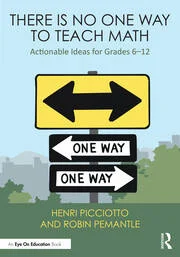
Amanda Cangelosi offers a professional development course for math teachers in Utah. In this guest post, she argues that There Is No One Way to Teach Math (a book I co-authored with Robin Pemantle) effectively complements Liljedahl’s Building Thinking Classrooms. She uses both as textbooks in her course.
Mentoring and Coaching
Margot Schou, a department chair, shares her thoughts on how we transmit teacher know-how to the next generation of educators. I am proud that she cites "Henri-isms" as framing part of her approach.
Homeschooling
I created my website mostly for the use of my fellow math teachers, but it appears that it is also visited by graduate students, adults trying to learn the math they didn't learn in school, and parents of homeschooled kids. Of course, all are welcome. This letter is from a representative of the latter group.
MathEducation.page
Visit my website!
Functions and Rate of Change
If a concept is important, we should teach it more than once, and preferably in more than one way. I recently expanded my Rate of Change home page to spell out where its links will take you — ten quite different destinations. This was based on a recent blog post where I analyzed the pedagogical thinking behind having so many approaches, and the specific teaching concepts underlying each one.
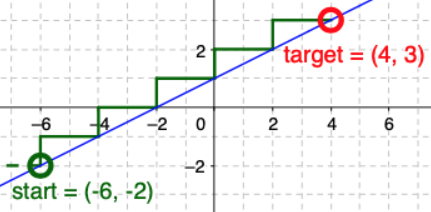
Rate of change (aka slope) is of course a specific focus within the broader topic of functions, a crucial and foundational concept in grades 8-12. Over the decades, I developed many lessons, applets, and activities on functions. You can find links to many of them on my Functions home page.
See also Recognizing Functions, a page with links to some of the same material, from a specific lens: how does one find the formula for a function, starting from its graph? from a table? from a geometric context? from an experiment? from a function diagram?
Learning Tools
A recurrent feature of my teaching and curriculum creation is the use and development of learning tools. Chief among those:
- The Lab Gear: a comprehensive hands-on environment for algebra, from middle school basics to completing the square.
- The Geoboard: a microworld rich in possible explorations: slope, the Pythagorean theorem, simplifying radicals, and more.
- The Ten-Centimeter Circle: a powerful very concrete introduction to trigonometry.
See also my Geometric Puzzles home page.
More Links!
- Most-visited pages in the last eight months, in order:
- Virtual Grid Paper
- Virtual Geoboard
- Virtual Pentominoes
- Virtual Base-Ten Blocks
- Virtual Circle Geoboard
- Virtual Tangrams
- Fraction Arithmetic
- Proving Pick's Formula
- Apparently my Geogebra-based virtual manipulatives are a hit!
Find them all on my Applets Home Page.
- Most-visited directories:
- Home Page
- Search
- For a Tool-Rich Pedagogy
- Manipulatives
- Fractions
- Site Map by Grade Level
- Pentominoes Home Page
- Geometry of the Parabola
